
Spatial machine learning has become a standard tool for producing environmental and geographic prediction maps. It is now relatively (technically) easy to combine field observations with remote sensing, climate, terrain, or other predictor layers and fit a strong machine learning model. The harder question is whether the resulting map is reliable, transferable, and reproducible.
In our paper, Navigating challenges in spatial machine learning: validation, uncertainty, algorithms, and reproducibility, we discuss this question from several connected angles. The paper was written by Jakub Nowosad, Carmelo Bonannella, Darius Görgen, Marta Jemeljanova, Teja Kattenborn, Jan Linnenbrink, Hanna Meyer, Madlene Nussbaum, Luca Patelli, Rolf Simoes, and Evelyn Uuemaa1, and published in Erdkunde.
The main argument is that spatial machine learning cannot simply reuse standard machine learning habits without modification. Spatial dependence, clustered and biased sampling, heterogeneous landscapes, and domain transfer all affect how models should be evaluated and interpreted. A model can appear accurate under a standard validation approach and still be unreliable where predictions are needed.
We structure the paper around six themes:
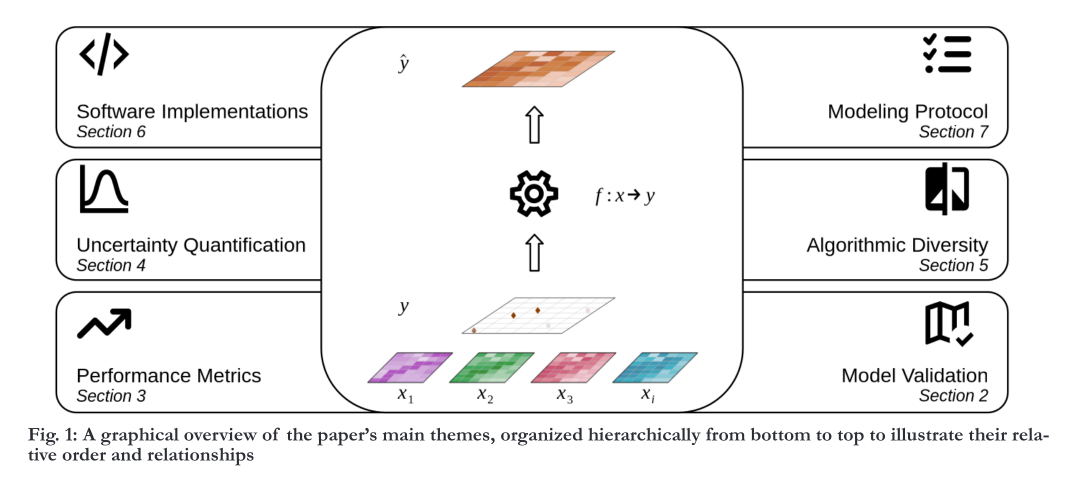
Several practical messages follow from this. Validation should match the intended prediction scenario, and prediction-domain adaptive evaluation approaches can help when sticking just to simple random or spatial cross-validation is not appropriate. When training data do not represent the prediction domain, areas outside the model’s area of applicability should be identified, masked, or at least communicated clearly. Performance should not be reduced to a single global number: residual maps, spatial patterns of error, uncertainty, and thinking of the goal of the analysis are all important.
The paper also highlights that algorithmic progress alone is not enough. We need benchmark datasets with different spatial properties, clearer comparisons against baseline methods, better uncertainty frameworks, and software that makes robust spatial workflows easier to apply. R currently has several dedicated tools for spatial machine learning workflows, while Python has a strong general-purpose machine learning ecosystem but fewer mature implementations of spatial-specific methods. In both languages, reproducibility still depends heavily on careful reporting of data preparation, resampling, prediction, software versions, and computational choices.
The final part of the paper argues for standardized reporting protocols for spatial machine learning. Such protocols could help researchers document modeling aims, spatial characteristics of the data, validation design, uncertainty treatment, computational requirements, and reproducibility materials. This is also connected to ongoing work on the Spatio-Temporal Modelling Protocol (STeMP).
The short version is this: spatial machine learning needs to move beyond performance-driven mapping toward workflows that are spatially explicit, uncertainty-aware, and reproducible. Better models are useful, but better evaluation, clearer uncertainty communication, stronger software, and transparent reporting are equally important.
Footnotes
And builds partly on discussions from the Advances in Spatial Machine Learning 2025 workshop. Many thanks to the workshop participants for their feedback and ideas!↩︎
Citation
@online{nowosad2026,
  author = {Nowosad, Jakub},
  title = {Navigating {Challenges} in {Spatial} {Machine} {Learning}},
  date = {2026-09-08},
  url = {https://jakubnowosad.com/posts/2026-09-08-erdkunde/},
  langid = {en}
}
