Simulating covariates and outcomes
Jakub Nowosad
2026-07-24
Covariates-and-outcomes.RmdLet’s start by attaching the necessary packages and setting the seed.
Next, we specify a raster template for the simulations.
rast_grid = terra::rast(xmin = 0, xmax = 200, ymin = 0, ymax = 200,
                        ncols = 200, nrows = 200)
Simulate
We can simulate any number of covariates using the
sim_covariates() function. This function is flexible: it
accepts simulation engines created by functions like
simulate_gaussian() or simulate_random(). This
allows for reusable simulation configurations.
The first example uses simulate_gaussian() with just a
range parameter to simulate four covariates for the
provided raster grid. The rest of the arguments (e.g., beta
representing the average value of the field, nmax
representing the number of nearest observations used for kriging
simulation, and psill representing the sill of the
variogram model) are set to default values.
covariates_one = sim_covariates(rast_grid, n = 4,
                                method = simulate_gaussian(range = 10))
terra::panel(covariates_one, nr = 1, col.main = "white")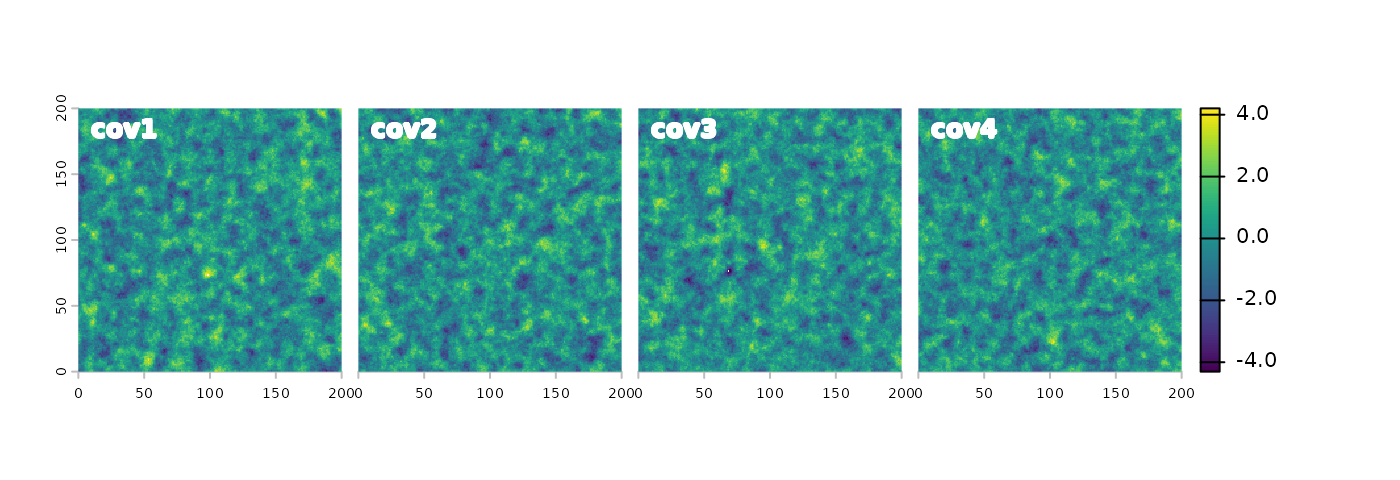
The second example uses a complete variogram model to simulate four covariates for the provided raster grid. Here, we specify not only the range but also the model type (exponential) and the sill of the variogram model.
covariates_two = sim_covariates(rast_grid, n = 4,
                                method = simulate_gaussian(vgm = gstat::vgm(model = "Exp", psill = 1, range = 10)))
terra::panel(covariates_two, nr = 1, col.main = "white")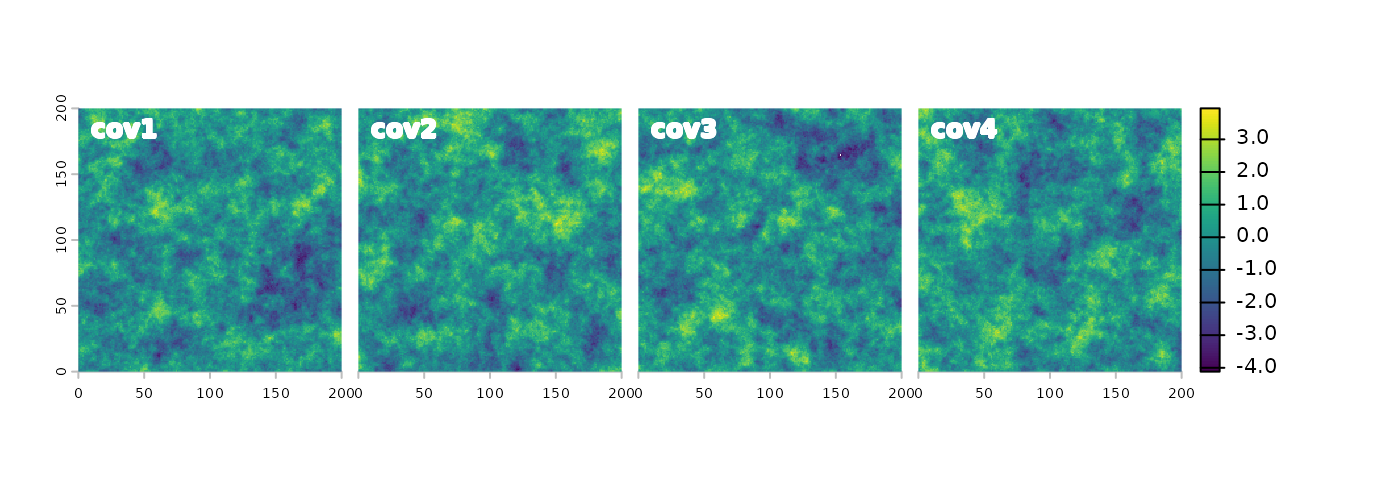
The third example uses a nugget effect to simulate four covariates without any spatial correlation.
covariates_three = sim_covariates(rast_grid, n = 4,
                                  method = simulate_gaussian(vgm = gstat::vgm(model = "Nug", psill = 2, range = 0)))
terra::panel(covariates_three, nr = 1, col.main = "white")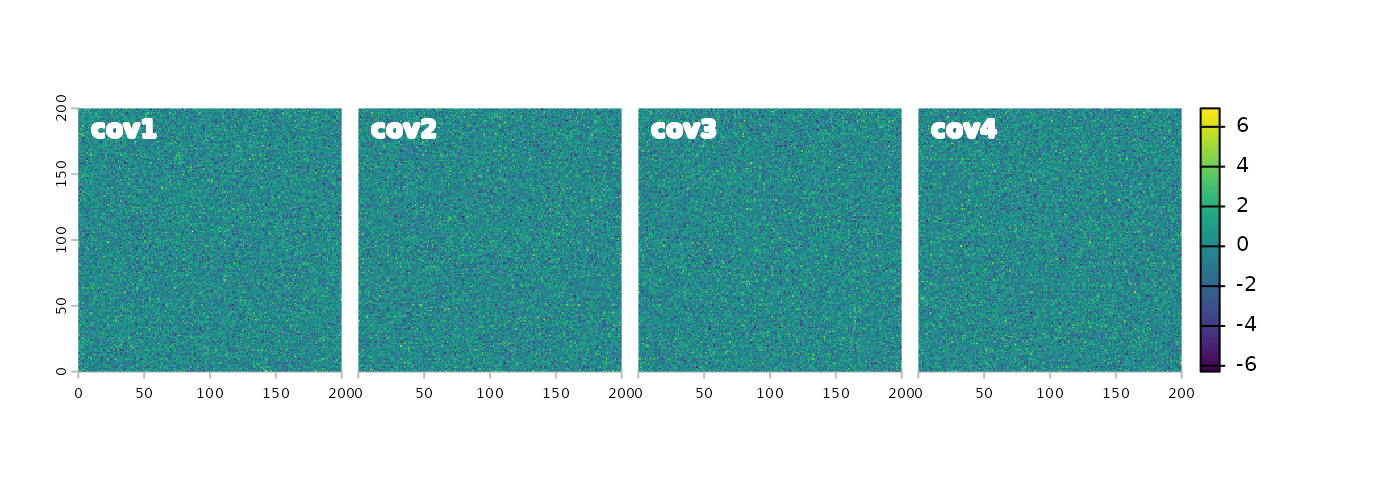
The last example creates a single simulation of a binary outcome
(indicators = TRUE) based on a specified variogram model
and a beta value. When indicators = TRUE, the simulation
produces categorical values (0/1) rather than continuous values. The
result depends on the specified variogram model and the beta value
(which represents the mean of the underlying Gaussian field).
covariates_four = sim_covariates(rast_grid, n = 1,
                                method = simulate_gaussian(vgm = gstat::vgm(model = "Exp", psill = 10, range = 100), beta = 30, indicators = TRUE))
terra::plot(covariates_four, nr = 1, col.main = "white")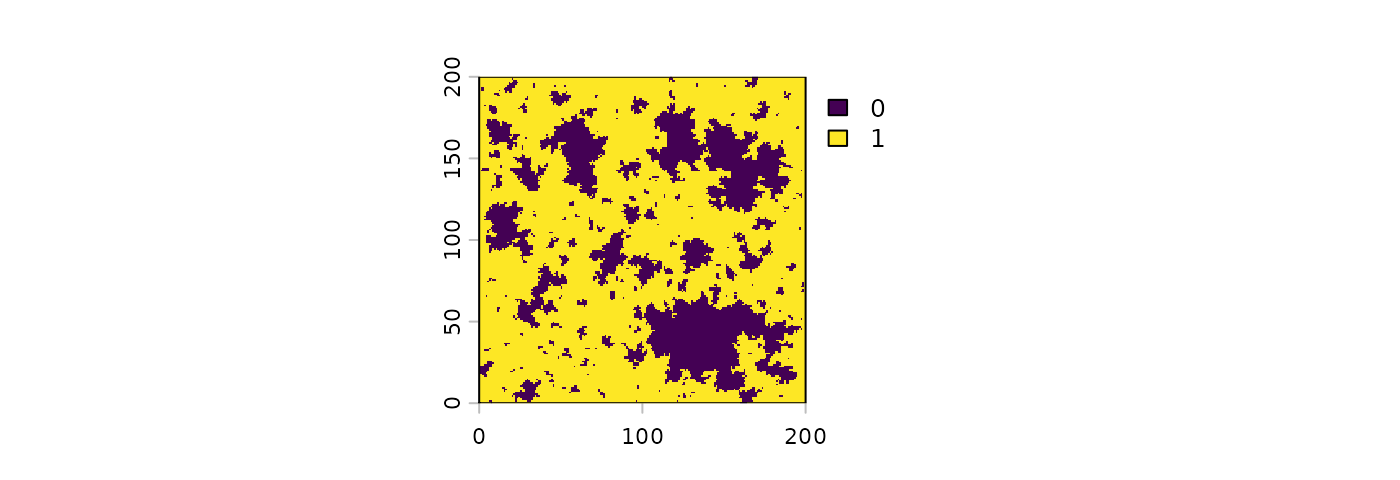
Blend
The sim_covariates() creates new rasters. Now, we can
blend these rasters to create new outcomes with the
blend_rasters() function. This function accepts one or more
SpatRaster objects, and a formula that specifies how to
combine them. Let’s try it out on a few examples.
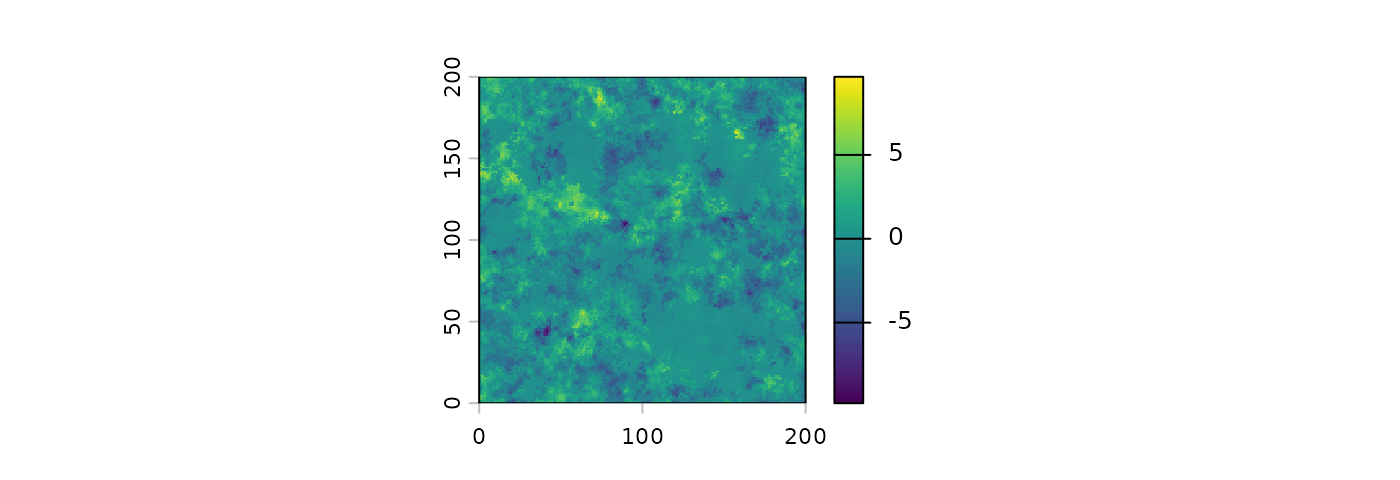
The first new raster is based on the first set of covariates and a formula that combines them by adding them together.
outcome_one = simsam::blend_rasters(covariates_one, ~ cov1 + cov2 + cov3 + cov4)
terra::plot(outcome_one)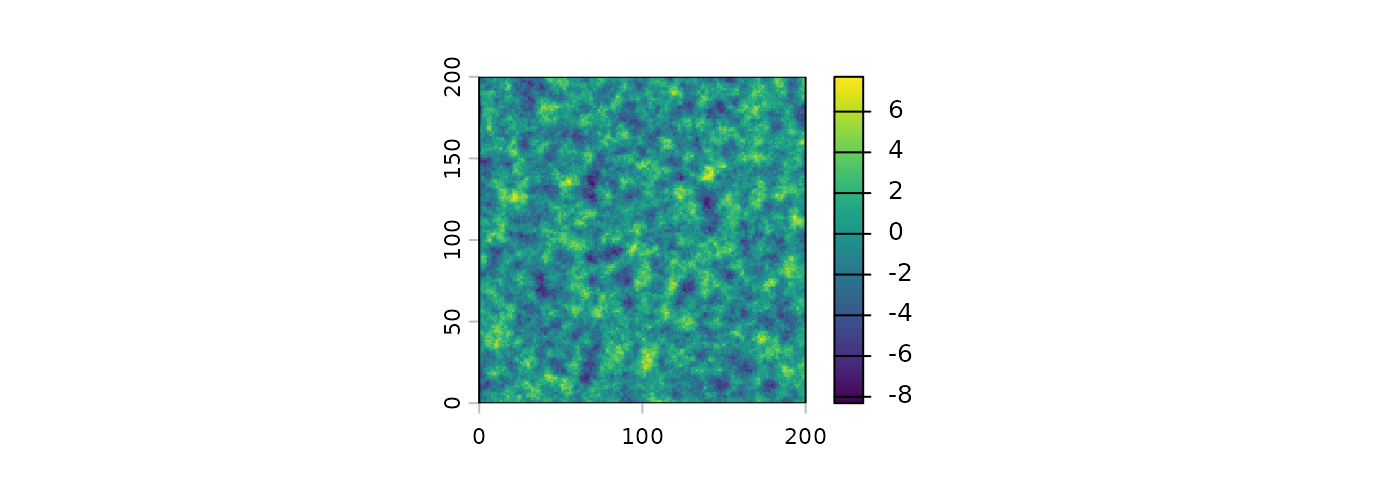
The blend_rasters() function can also be used to further
blend the outcomes with additional covariates. Here, we are adding a
random noise (cov1 from covariates_three) to
the outcome.
outcome_two = simsam::blend_rasters(outcome_one, ~ outcome + cov1, covariates_three)
terra::plot(outcome_two)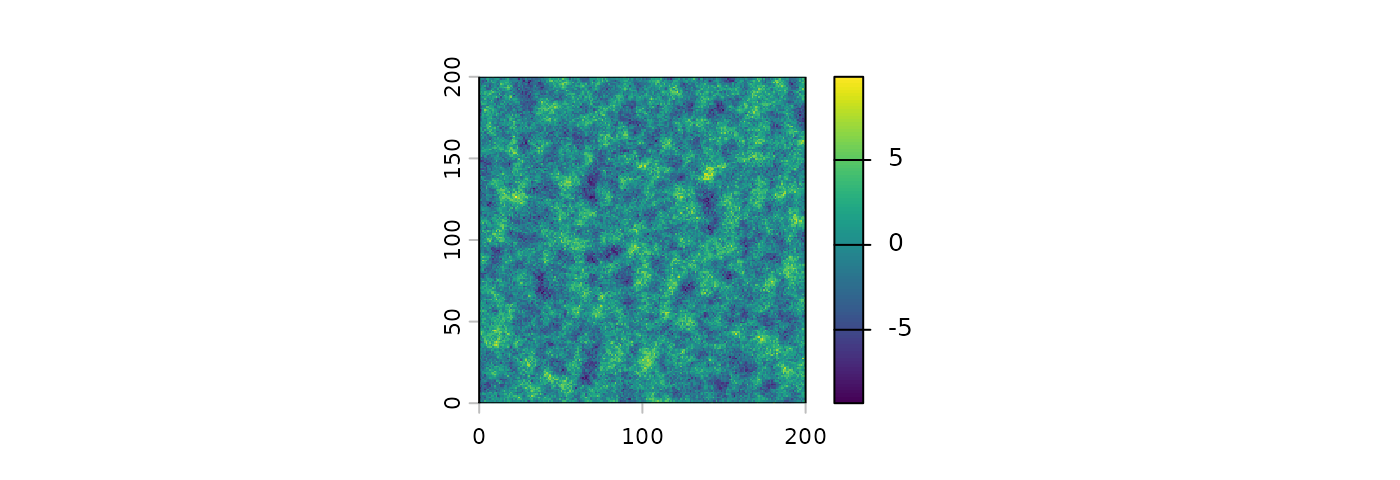
The third example shows how to blend the first created outcome with a
binary covariate (cov1 from covariates_four).
Additionally, it also highlights the flexibility of the formula
notation, which allows, for example, the use of various mathematical
operations and constants.
outcome_three = simsam::blend_rasters(outcome_one, ~ outcome * (cov1 + 0.2), covariates_four)
terra::plot(outcome_three)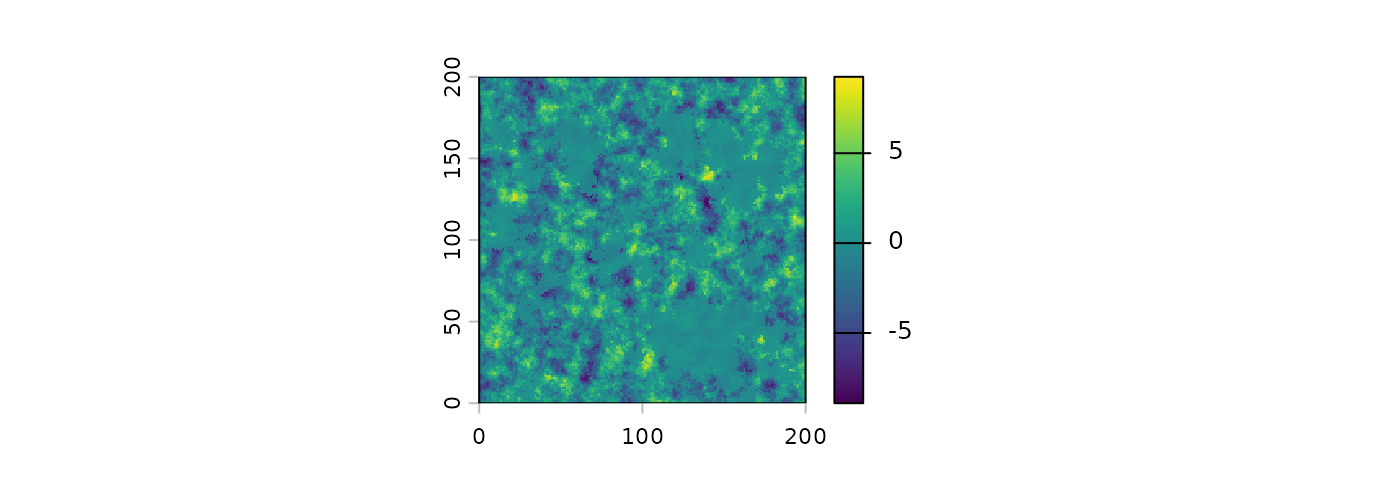
Finally, the last example shows that the blend_rasters()
function can be used in a pipe-like manner.
outcome_four = simsam::blend_rasters(covariates_two, ~ cov1 + cov2 * cov3 + cov4) |>
  simsam::blend_rasters(~ outcome * (cov1 + 0.2), covariates_four)
terra::plot(outcome_four)