Creates supercells from single- or multi-band rasters using an extended SLIC algorithm.
The function supports either a target number of supercells (k) or a fixed grid
spacing (step), as well as optional custom centers and chunking.
Usage
sc_slic(
  x,
  step = NULL,
  compactness,
  dist_fun = "euclidean",
  avg_fun = "mean",
  clean = TRUE,
  minarea,
  iter = 10,
  k = NULL,
  centers = NULL,
  outcomes = c("supercells", "coordinates", "values"),
  chunks = FALSE,
  verbose = 0
)
Arguments
- x
An object of class SpatRaster (terra) or class stars (stars).
- step
Initial center spacing (alternative is
k). Provide a plain numeric value for cell units, or useuse_meters()for map-distance steps in meters (automatically converted to cells using raster resolution).- compactness
A compactness value. Use
sc_tune_compactness()to estimate it. Useuse_adaptive()to enable adaptive compactness (ASLIC).- dist_fun
A distance function name or a custom function. Supported names: "euclidean", "jsd", "dtw", "dtw2d", or any method from
philentropy::getDistMethods(). A custom function must accept two numeric vectors and return a single numeric value.- avg_fun
An averaging function name or custom function used to summarize values within each supercell. Supported names: "mean" and "median". A custom function must accept a numeric vector and return a single numeric value.
- clean
Should connectivity of the supercells be enforced?
- minarea
Minimal size of a supercell (in cells).
- iter
Number of iterations.
- k
The number of supercells desired (alternative to
step).- centers
Optional sf object of custom centers. Requires
step.- outcomes
Character vector controlling which fields are returned. Allowed values are "supercells", "coordinates", and "values". Default is full output (
c("supercells", "coordinates", "values")). Useoutcomes = "values"for value summaries only.- chunks
Chunking option. Use
FALSEfor no chunking,TRUEfor automatic chunking based on size, or a numeric value for a fixed chunk size (in number of cells per side).- verbose
Verbosity level.
Value
An sf object with the supercell polygons and summary statistics.
Information on step, compactness, and compactness_method are attached to
the result as attributes (compactness is NA for adaptive compactness).
Details
Use sc_slic() for polygon outputs. For raster or point centers outputs, see
sc_slic_raster() and sc_slic_points().
Evaluation and diagnostic options:
Iteration convergence: use
sc_slic_convergence()and plot its output.Pixel diagnostics:
sc_metrics_pixels()for per-pixel spatial, value, and combined distances.Cluster diagnostics:
sc_metrics_supercells()for per-supercell summaries.Global diagnostics:
sc_metrics_global()for a single-row summary.
References
Achanta, R., Shaji, A., Smith, K., Lucchi, A., Fua, P., & Süsstrunk, S. (2012). SLIC Superpixels Compared to State-of-the-Art Superpixel Methods. IEEE Transactions on Pattern Analysis and Machine Intelligence, 34(11), 2274–2282. https://doi.org/10.1109/tpami.2012.120
Nowosad, J., Stepinski, T. (2022). Extended SLIC superpixels algorithm for applications to non-imagery geospatial rasters. International Journal of Applied Earth Observation and Geoinformation, https://doi.org/10.1016/j.jag.2022.102935
Examples
library(supercells)
# One variable

vol = terra::rast(system.file("raster/volcano.tif", package = "supercells"))
vol_slic1 = sc_slic(vol, step = 8, compactness = 1)
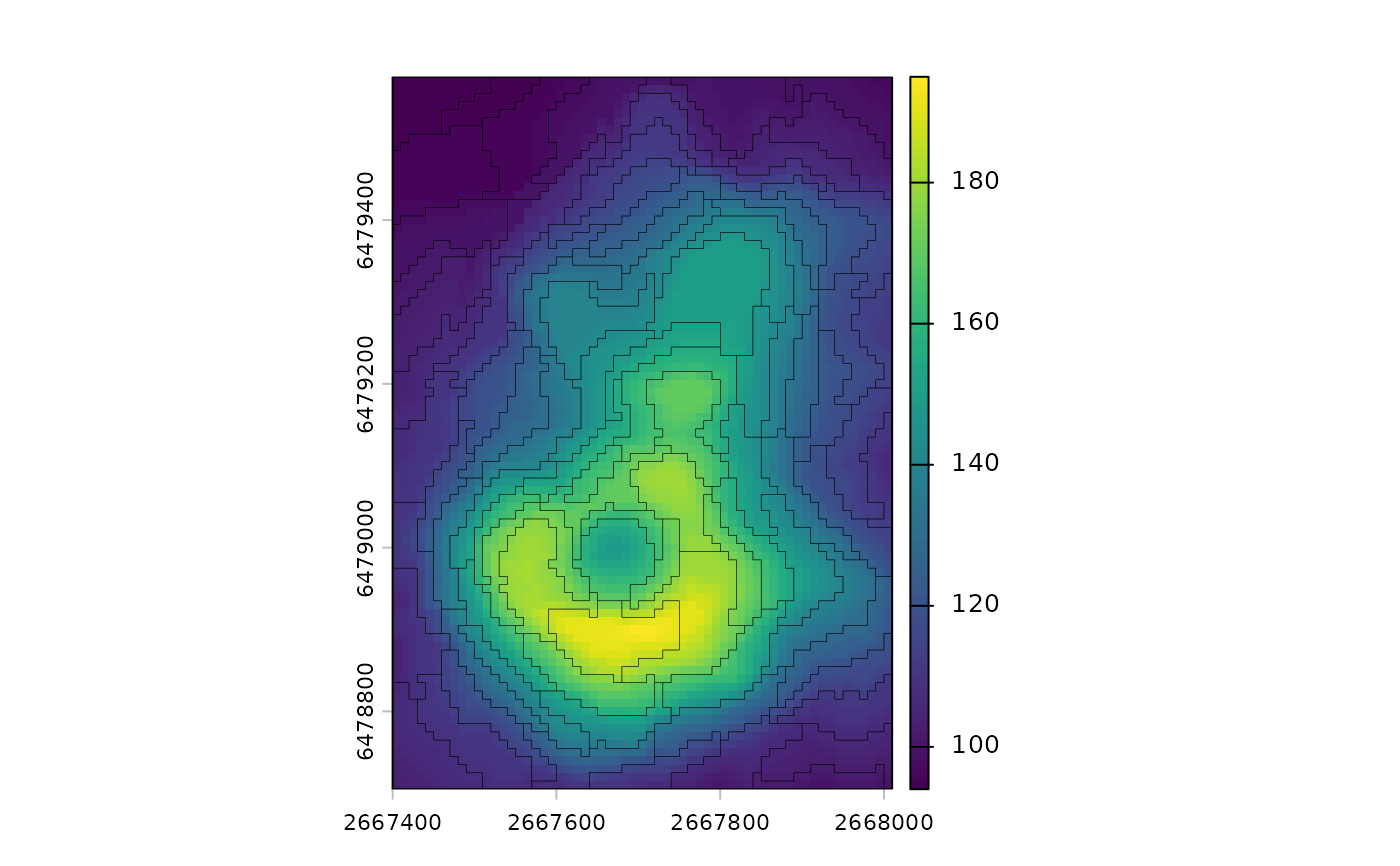
terra::plot(vol)
plot(sf::st_geometry(vol_slic1), add = TRUE, lwd = 0.2)